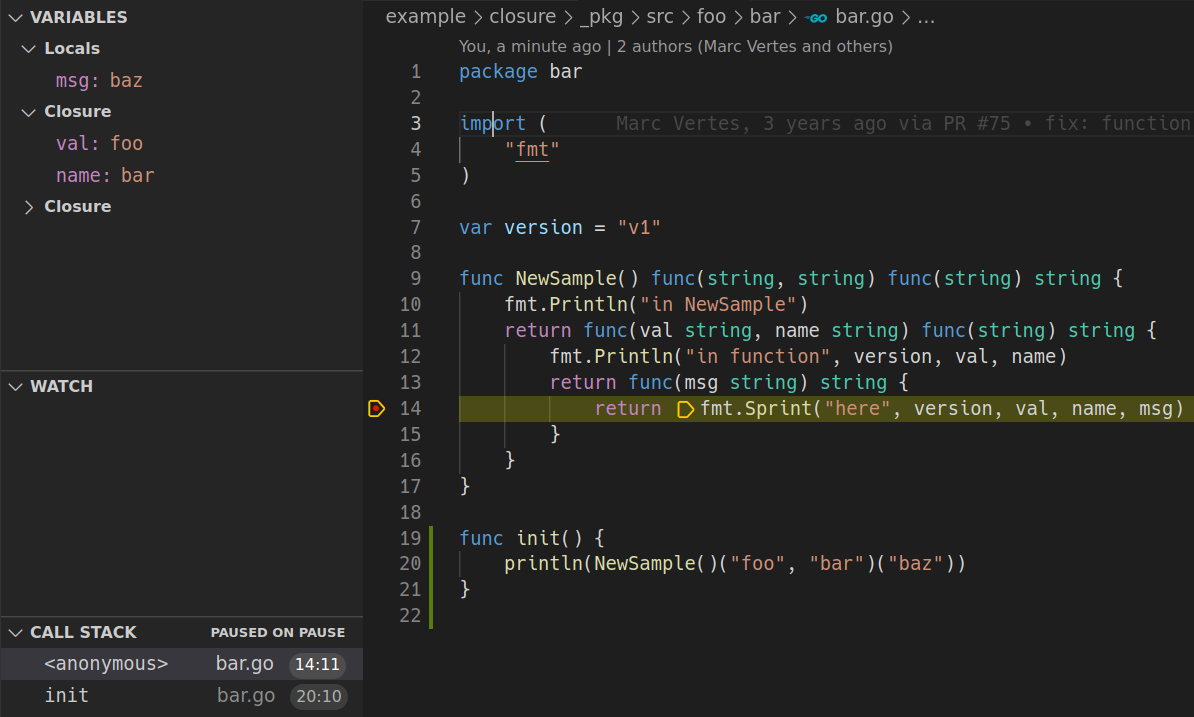
Make sure to keep always a single copy of incomplete type structures.
Remove remnants of recursive types processing.

Now `import "go.uber.org/zap"` works again (see #1172), fixing regressions
introduced since #1236.
This adds `itype.str` which is a string representation of the type built when the type is built. The goal is to make type comparison simpler and centralise the creation of types just to constructors and `nodeType`. `nodeType` continues to build types in parts so to reuse underlying types better.
Add getConcreteType to retrieve the concrete type of a nested interface
value implementing a specific interface for which a wrapper exists.
If method resolution fails at runtime, a panic is now issued instead
of an error message and continue.
Fixes#1187.
The resolution method was not compliant with the Go specification which
requires to retain the object where the field or method is the most
shallowed.
The detection of ambiguous fields or methods (same depth in different
objects) has also been added.
Fixes#1163.
In selector resolution, struct field matching now precedes
method matching. Before struct field matching could be skipped
in case of a matching method, which is incorrect, as demontrated
by _test/issue-1156.go.
Field lookup has been fixed to operate on recursive structures.
Concrete type values are derived when filling a receiver for
interface methods.
LookupBinField has been fixed to skip non struct values.
LookupMethod has been fixed to iterate on interface values as
well as concrete type values.
Fixes#1156.
Fixes#1151
If I add a package with `Use` and import it with `ImportUsed`, the package is added to the universe scope as `<pkg>`. If I import with `Eval`, the package is added as `<pkg>/_.go`. However, `(*node).isType` (in cfg.go) only checks for `<pkg>/_.go`. Thus, packages imported with `ImportUsed` can be inaccessible.
This MR updates `(*node).isType` to fall back to `<pkg>` if `<pkg>/_.go` does not exist.
In typecheck.go, detect binary methods so we know when to skip the receiver as first parameter when checking function signatures. The signature check is not yet performed, we just avoid a false error.
In cfg.go, take care to label types with isBinMethod field to true whenever a binary method is resolved.
Also, do not attempt to wrap node in functions if the node value is already a binary function.
Fixes#1145.
This is a small change that allows use of composite array literals, such as:

```go
type Vec3 [3]float32

var foo = []Vec3{
	{1, 0, 0},
	{6, 0, 0},
	{6, 2, 0},
	{2, 2, 0},
	{1, 1, 0},
}
```
In switch case expressions, the condition on case clause was
not always properly evaluated. Reverse the order of case clause
evaluations (as already done for if-else-if fashion), and fix the
wiring to false-next and true-next nodes.
Fixes#1126.
In binary packages, constants are wrapped in constant.Values, to
support arbitrary precision. Their type must therefore be converted
back to a regular type at import.
Fixes#1101.
In this range variant "for k, v := range aString", k must
be the byte position of the rune in the byte array, rather than
the index of the rune in the rune array.
Fixes#1088.
In that case, direct propagation of result can not be attempted,
as the frame types will be different between the source and destination.
Disabling the optimisation and using The regular case involves an intermediate
frame entry, which enables the type conversion.
Fixes#1091.
The heuristic to generate a package name identifier was incorrect. Now for binary packages, the package identifier is obtained by a symbol, generated by extract, which contains the string argument of package statement in source file. This should ensure an always correct default package identifier.
Fixes#1095.
Avoid to test directly for a type category, as it may give wrong
results for aliased types, where the interesting category remains
masked. Instead, use some property helpers, such as isFuncSrc,
isPtrSrc and isInterfaceSrc to check if a type is of source function,
source pointer or source interface respectively (versus runtime
defined function, pointer or interface).
Fixes#1068.
Offsetof returns the offset of a field in a struct. It is computed
during parsing at CFG, due to the constraint of operating on a
struct selector expression.
With this function, the support of 'unsafe' package is now
complete in yaegi.
Fixes#1062.
Add missing `sliceT` type category for consistency. Remove
`sizedef` field in `itype` struct. Rename field `size` to `length`.
Clean the various hacks used to cope with the absence of `sliceT`.
This PR:
- Treats a `varDecl` within a block as a `defineStmt`
- More specifically, any `varDecl` with a grandparent that is *not* a `fileStmt`
- Adds an extra condition to the handler for implicit const assignment
- Adds a tests to cover the changes
- Closes#1071
Functions in a struct fields are always wrapped (as potentially
used by the runtime), so generate a function wrapper also for
closure when assigned to a struct field.

When such a function is called from the interpreter, ensure that
interface arguments are also wrapped so method and receiver resolution
can be performed.

Fixes partially #1043.
The first change forces a variable definition to reallocate a
new memory slot to avoid corrupting a previously defined one in
a loop block.
The second change ensures that the frame clone operations obtains
a copy of the original data slice, to preserve the original context
set in a loop.
Fixes#1035.
The empty interface (interface{}), and its variants (such as []interface{} and map[string]interface{}), are commonly used in Go to (json) Unmarshal arbitrary data. Within Yaegi, all interface types are wrapped in a valueInterface struct in order to retain all the information needed for a consistent internal state (as reflect is not enough to achieve that). However, this wrapping ends up being problematic when it comes to the type assertions related to the aforementioned Unmarshaling.
Therefore, this PR is an attempt to consider the empty interface (and its variants) as an exception within Yaegi, that should never be wrapped within a valueInterface, and to treat it similarly to the other basic Go types. The assumption is that the wrapping should not be needed, as there is no information about implemented methods to maintain.
Fixes#984Fixes#829Fixes#1015
When checking for untyped values, we can be sure at this stage that they must be a const value or already untyped. Checking for type string equality is no longer a good measure.
Fixes#1000
This is a follow-up of #1014, where an invalid constant definition involving a builtin is now checked at CFG. In addition, some missing arithmetic operators are now detected for assign optimization.
In some cases, the global character of a value was lost, leading to
undefined behaviour. Now a node level field of -1 means that the value
is global, and that it should be accessed from the root data frame.
Fixes#993.
The interpreter interface type was replaced by a reflect.Value in
objects passed or return to function wrappers, losing the ability
to retrieve methods.
The valueInterface is now preserved, and correctly accessed if
wrapped multiple times.
Fixes#977.
typeAssertStatus deals with the 3rd form of type assertion ("_, ok"), for
when one does not care about the result of the assertion itself.
Some cases for it, which are already fixed for the two other forms of
type assertions, had not been fixed for this form yet.

Therefore, this change fixes such cases for this form, while integrating
typeAssertStatus to the same code path as for the two other forms.
In aliased type declarations, when the target type was imported from
an external package rather than declared locally, the aliased type was
overwritten by target, loosing ability to lookup methods on the aliased
type. Aliasing on imported types is now properly detected and handled.
Fixes#971.
As opposed to other symbols, goto labels must be searched in included
scopes, not upper ones. Implement scope.lookdown to perform this,
to allow calls to goto to be embedded in included scopes where label
is defined.
Fixes#953.
Perform function declaration type check from the upper level scope (the scope where the
function is declared), to avoid possible collisions of local variables with package names.
Fixes#957.