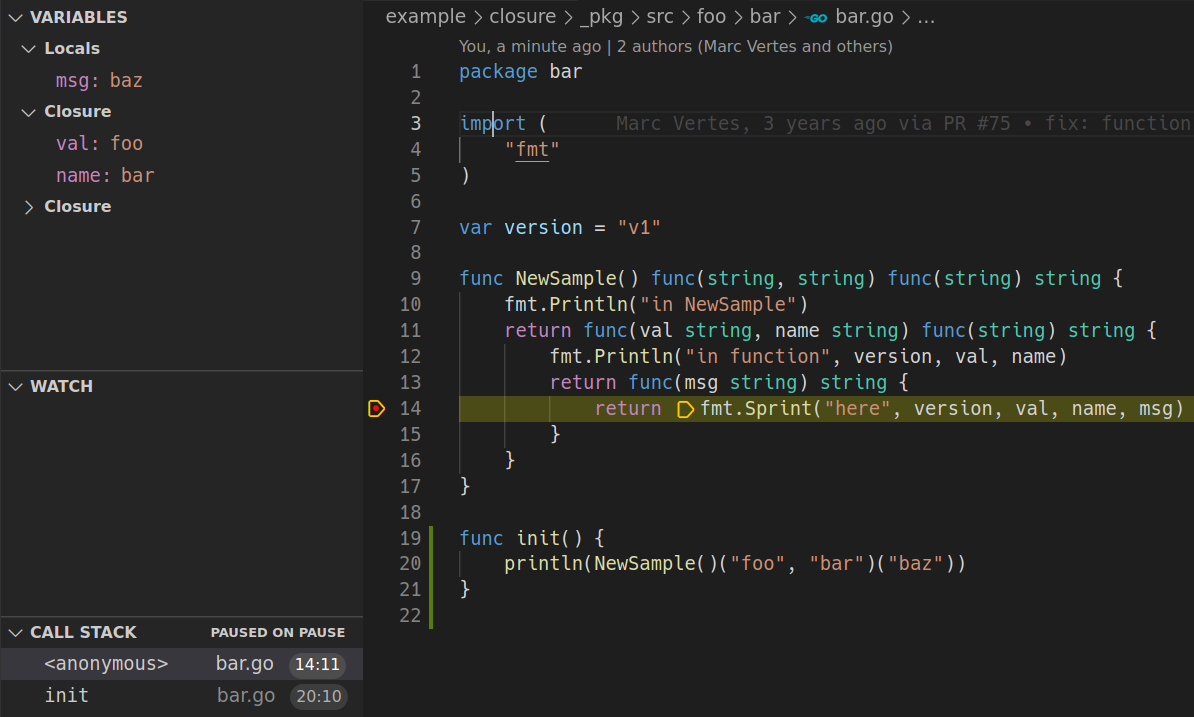
This builds on #1644 and adds automatic per-loop variables that are consistent with go 1.22 behavior.  See #1643 for discussion.

This is still a draft because the for7 version ends up capturing the per-loop var values when they are +1 relative to what they should be.  Maybe somehow the incrementing and conditional code is somehow capturing the within loop variables and incrementing them?  not sure how that would work.  anyway, need to investigate further before this is ready to go, but pushing it here in case there are other issues or someone might figure out this bug before I do..
This fixes issue #1634

includes special case for defer function.

I could remove or significantly reduce the comment description, and just have that here for future reference:

// per #1634, if v is already a func, then don't re-wrap!  critically, the original wrapping
// clones the frame, whereas the one here (below) does _not_ clone the frame, so it doesn't
// generate the proper closure capture effects!
// this path is the same as genValueAsFunctionWrapper which is the path taken above if
// the value has an associated node, which happens when you do f := func() ..
Currently, yaegi only records source positions when writing panic trace to stderr.

This change adds function names to the panic output.

Unfortunately, yaegi walks the trace in reverse order, comparing to Go runtime. This can be improved in the future.
In the case of a Go short definition (i.e. `a, b := f()`), the new defined variables must be (re-)created in order to preserve the previous value (if in a loop) which can be still in use in the context of a closure. This must not apply to redeclared variables which simply see their value reassigned.
The problem was both occuring in callBin() for runtime functions and assignFromCall() for functions created in the interpreter.
Fixes#1497.
hi!
this issue is sorta blocking for me so i thought i would try to fix it.
im still learning the codebase and understanding how yaegi works, but I thought I would attempt to add a test in the style of other tests as a start.
please let me know if there is anything i need to change / run, or if anyone knows perhaps a good place to start for tackling this issue
Fixes#1496
closes#1514
hi!
I had the same problem as #1514 and I wanted to fix it, I found
When asserting *crypto/rsa.PublicKey, using the typ attribute of node to get an nil rtype, resulting in the assertion result being nok
This code contains the same problem
```go
package main
import (
"log"
"crypto/rsa"
)
func main() {
var pKey interface{} = &rsa.PublicKey{}
if _, ok := pKey.(*rsa.PublicKey); ok {
log.Println("ok")
} else {
log.Println("nok")
}
}
```
So I submitted this Pull Request, hope it will be merged
For methods defined on interfaces (vs concrete methods), the resolution of the method is necessarily delayed at the run time and can not be completed at compile time.
The selectorExpr processing has been changed to correctly identify calls on interface methods which were confused as fields rather than methods (due to the fact that in a interface definition, methods are fields of the interface).
Then at runtime, method lookup has been fixed to correctly recurse in nested valueInterface wrappers and to find embedded interface fields in case of struct or pointer to struct.
Finally, remove receiver processing in `call()`.The receiver is already processed at method resolution and in genFunctionWrapper. Removing redundant processing in call fixes handling of variadic method, simplifies the code and makes it faster.
With those fixes, it is now possible to load and run `go.uber.org/zap` in yaegi. In turn, it makes possible for yaegi to run plugins dependent on zap, such as coraza-waf.
Fixes#1515,
Fixes#1172,
Fixes#1275,
Fixes#1485.
It allows to use interpreter functions as parameters in the runtime, even for defered callbacks, or when passed as empty interfaces, as for runtime.SetFinalizer.
Fixes#1503
For a long time, there was a confusion between aliased types and named types (due to my misunderstanding of alias types in Go at that time). The type category `aliasT` has been renamed into `linkedT`, which is correct semantically.
Aliased types are only declared using `typeSpecAssign`, and its processing is now distinct from `typeSpec` statement, used for named types.
A `linkedT` type is obtained by a statement like `type A uint32`, where `A` type category is therefore `linkedT`.
An aliased type is obtained by a statement like `type A = uint32` (notice the `=` sign, translating into `typeSpecAssign`).
The semantic difference is that in the first linkedT form, `A` and `uint32` are 2 distinct types, instead of being strictly equivalent in the `typeSpecAssign` form (the 2 names lead to one type definition).
Fixes#1416.
Up to now functions could be stored as node values in frame (as for interpreter defined functions) or function values, directly callable by the Go runtime. We now always store functions in the later form, making the processing of functions, anonymous closures and methods simpler and more robust. All functions, once compiled are always directly callable, with no further wrapping necessary.
Fixes#1459.
Although empty interfaces are usually not wrapped, for compatibility with the runtime, we may have to wrap them sometime into `valueInterface` type.
It allows to preserve interpreter type metadata for interface values exchanged with the runtime. It is necessary to resolve methods and receivers in the absence of reflect support.
During type assertions on empty interfaces, we now handle a possible valueInterface and dereference the original value to pursue the type assertion.
In the same change, we have improved the format of some panic messages at runtime to give location of offending source at interpreter level.
This change will allow to fixtraefik/traefik#9362.
The representation of non empty interfaces defined in the interpreter is now identical between refType() and frameType() functions, which are used to generate interpreter objects.
Fixes#1447 and #1426.
This change implements a workaround to better support composed
interfaces in yaegi and let the interpreter define objects which
implement multiple interfaces at once.
We use the existing MapTypes to store what possible composed interface
wrapper could be used for some interfaces. When generating an interface
wrapper, the wrapper with the highest number of implemented methods is
chosen.
This is still an imperfect solution but it improves the accuracy of
interpreter in some critical cases.
This workaround could be removed in future if/when golang/go#15924
is resolved.
Fixes#1425.
The function `getMethodByName()` is now able to look for
embedded `valueInterface` field for matching methods in interface
struct fields.
Fixes#1439 and #1427.
We finally address a long standing limitation of the interpreter:
the capacity to generate the correct interface wrapper for an
anonymous interface{} function parameter of a binary function.
It allows for example fmt.Printf to invoke the String method
of an object defined within the interpreter, or json.Marshal
to invoke a textMarshaler method if it exists and if there is
no Marshaler method already defined for the passed interpreter
object.
To achieve that, we add a new mapType part of the "Used" symbols
to describe what not empty interfaces are expected and in which
priority order. This information can not be guessed and is found
in the related package documentation, then captured in stdlib/maptypes.go.
Then, at compile time and/or during execution, a lookup on mapTypes
is performed to allow the correct wrapper to be generated.
This change adds a new MapType type to the stdlib package.
Fixes#435.
In that case, the interface must be wrapped in an valueInterface
at creation.
With that fix, it is now possible to import
github.com/google/go-querystring/query. Not tested beyond that.
Fixes#1123.
At variable, function parameter, slice, map or field element assign,
if the destination type is an empty interface, the value was never
wrapped into a valueInterface (to preserve type mutability in case
of re-assign). Now we wrap it in a valueInterface if the source
type has a non empty set of methods, to allow a future use as a non
empty interface.
There are still corner cases, but it extends notably the support
of interfaces within the interpreter.
Fixes#1355.
* interp: fix creation of binary composite types
Use direct assignment instead of reflect.Value Set method to
initialize a binary composite type, as for non binary types.
It ensures that a new reflect.Value is stored in the frame
instead of modifying a possibly existing one, which can defeat
the purpose of initializing variables in a body loop.
While there, remove the need to have and use a mutex on types.
Fixes#1381.
* review: rework a bit the test
Co-authored-by: mpl <mathieu.lonjaret@gmail.com>
The capability to dereference pointers has been added to
methodByName(), improving method lookup on binary values.
Wrapping to valueInterface is performed in a missing use case at
return of function calls. It was done in the nested call, but not
at assign.
Fixes#1330.
A runtime builtin assignFromCall is added to handle multiple values returned at once. It is necessary if some of the values require to be set to interface values in the caller space, which is performed by reflect.Set in assignFromCall.
Fixes#1311.
When an interpreter type implementing an interface is
used by the runtime, the runtime can extract its type
and create new values using reflect, and call methods
on it. The problem is that there will be no interpreted
method counterpart in this case, which makes wrapper panic.
Allow the String() method wrapper to always succeed and
return an empty string if no interpreted method is present.
This allows scripts to define custom flag.Value types on
which the runtime internally instantiates values using
reflect (see isZeroValue in Go src/flag/flag.go).
This workaround could be generalized to all wrappers if
necessary. At this moment, it is convenient to keep the
default behavior of expecting instantiated interpreter
methods, in order to catch interpreter bugs related to
interfaces.
Fixes#1276.
This change fixes a regression introduced by PR #1192 in a program using
https://github.com/NYTimes/gziphandler which defines several types
implementing stdlib interfaces. We do not implement a wrapper
if we see that a type already implements an interface, except that
it can be falsly reported by reflect in case of a struct with
embedded interface field. We need to force the wrapper generation
in this case.
The problem occurs only for wrappers on struct, not on pointers or
other indirection types.
This test (assert2.go) display 2 separate issues:
1. assert2.go L28: Type assert tries to set an `interface{}` to a `valueInterface`. The typing here is complex, we have a valueT(strings.Builder) wrapped in a ptrT wrapped in a src iface wrapped in a valueT(interface{}). Type assert fails to realise that the `valueT` `interface{}` is wrapping the `valueInterface`.
2. assert2.go L29: `genValueBinMethodOnInterface` does not try and get the bin method, as the `typ.node` (`ptrT` or a `valueT`(`string.Builder`)) is set. In this case the src iface is called with a receiver argument. To fix this the method is looked for first if possible, and only if not found does it fall back to the `defaultGen`.
Fixes#1227